
Pentest vs Red Team
Heard of both Penetration Testing (Pentest) and Red Team Assessments? They both aim to boost your cybersecurity, but their approaches and goals differ significantly.
May 6, 2025 · 3 min read
Penetration Testing (Pentest): The Focused Sniper
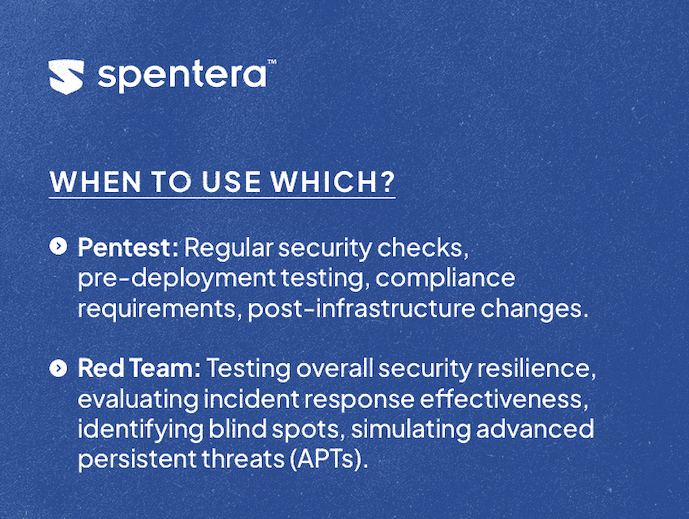
Think of a Pentest as a targeted security audit. Its goal is to identify and exploit specific vulnerabilities within a defined scope – a particular application, network segment, or system.
- Focus: Finding weaknesses and proving exploitability.
- Scope: Narrow and well-defined.
- Timeline: Typically shorter, from days to a few weeks.
- Methodology: Structured, often following industry standards (like OWASP).
- Outcome: A detailed report of vulnerabilities found, proof-of-concept exploits, and remediation recommendations.
Red Team Assessment: The Realistic Adversary
A Red Team Assessment takes a broader, more holistic approach. It simulates real-world cyberattacks to test your organization's overall security posture – including your people, processes, and technology.
- Focus: Evaluating your detection, response, and prevention capabilities against realistic threats.
- Scope: Broad and flexible, mimicking attacker tactics and techniques (TTPs).
- Timeline: Longer, often spanning several weeks to months.
- Methodology: Scenario-based, creative, and often unknown to the "Blue Team" (your internal security).
- Outcome: An evaluation of your organization's ability to withstand a sophisticated attack, highlighting weaknesses in your security as a whole.
Key Differences Summarized
- Goal: Pentest finds vulnerabilities. Red Team tests defenses.
- Scope: Pentest is narrow. Red Team is broad.
- Approach: Pentest is structured. Red Team is adversarial simulation.
Secure your Business Today
Contact us for a free consultation to discuss your cybersecurity needs.